The performance of the US economy and Artificial Intelligence (AI) continue to be key drivers of the investment environment.
The US economy has weathered the impact of a significant increase in tariffs in 2025 well. It is currently growing at a moderate underlying pace (around 2%), with core inflation on the high side of the US Federal Reserve’s 2% target. The US labour market is soft, although its deterioration is moderate – enough to for investors to expect the Fed to cut rates further but not enough to be unsettling. The markets are currently pricing the US Federal Reserve cutting rates by 0.5% this year.
AI-related capital expenditure of the US hyperscalers (Google, Microsoft, Meta and Amazon) is expected to be one of the key supports for the US economy. During the current US Q4 earnings season, their projected capital expenditure for 2026 has been revised higher from already elevated levels. The expected capex for 2026 is more than USD 0.6 trillion (around 2% of annual nominal US GDP), which is almost three times their collective capex in 2024.
Much of the capital expenditure of the US Hyperscalers is funded from free cash flow, resulting in these companies becoming riskier. They are effectively placing a large bet that they will be able to achieve strong returns from unprecedented levels of investment. Investors have recently become more circumspect about the outlook for these companies. Except for Google, each of them has materially underperformed the S&P 500 over the past 6 months.
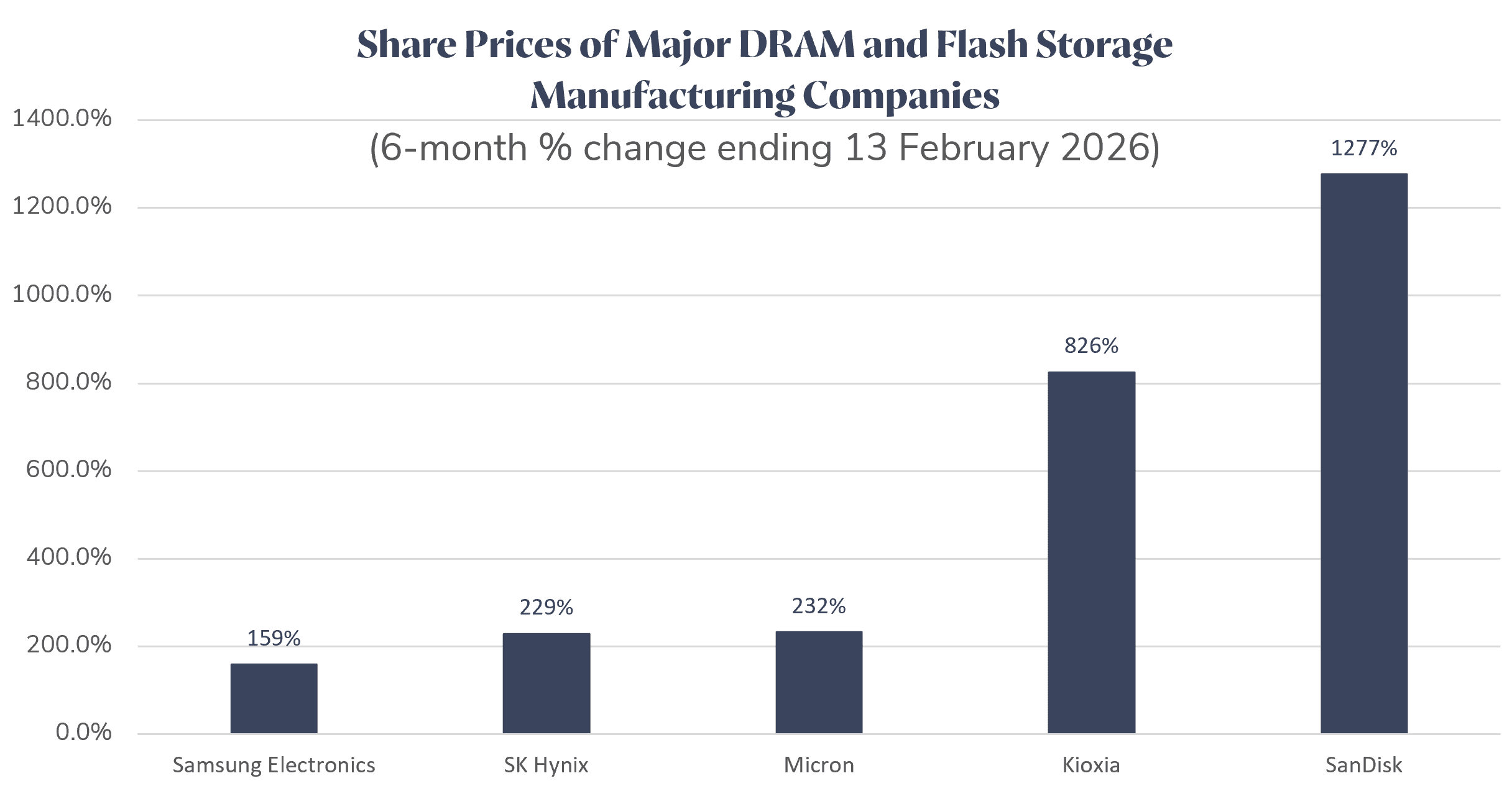
There are signs that the large data centre build-out associated with AI is hitting capacity constraints in some areas with memory prices (e.g. DRAM and flash memory) rising very sharply recently. The chart below shows that over the 6-months ending 13 February 2026, the share prices of manufacturers of DRAM and flash storage have increased extremely sharply, with SanDisk up over 1000%.
Along with providing support for US economic growth, AI has been a large contributor to profit growth of the US equity market. For example, it has been responsible for more than 60% of S&P 500 profit growth in Q4 2025.
In Australia, the RBA increased the cash rate from 3.6% to 3.85% in February 2026. This was the first change in the rate since August and the first increase since November 2023. The recent increase reflects higher than targeted inflation and signs that the Australia economy will grow at a faster pace in 2026 than in 2025.
Over the 12 months to December 2025, the underlying inflation rate (i.e. the trimmed mean measure) was 3.3% versus the targeted range of 2% to 3%. Markets are currently pricing the RBA to increase interest rates again in May. While higher rates are expected, a substantial increase in 2026 appears unlikely. Higher interest rates and rising commodity prices have recently helped push the Australian dollar above 70 cents versus the US dollar.
Outlook
While a range of scenarios are possible, most commentators are expecting that the US and Australian economies will grow at a moderate pace in 2026. Such an outlook would typically be supportive for equities, however, valuations in the US and Australia are elevated, which may limit upside. Such valuations can also mean that equities are vulnerable to a negative shock should that occur.
The key upside risk for equities is that AI results in even stronger productivity gains than are currently priced. Conversely, an important downside risk is that the large capital expenditure associated with AI does not generate the level of returns currently expected. Another important issue is the extent to which AI causes material dislocations in certain sectors of the economy from software to legal services.