As we near the end of the financial year, it’s a good time to think about making additional contributions to your super. Even a small amount may make a significant difference to your retirement savings over time, and it could also reduce your taxable income for the year.
There are different types of contributions that might be available to you – read on for more details, and if you have any questions, feel free to contact our friendly Member Services team.
Concessional (before tax) contributions |
|---|
The government limits how much you can put into your super before tax. So first things first, work out how much of your concessional contributions allowance you have used.
Concessional super contributions, including the super guarantee payments made by your employer, are generally taxed at 15%* rather than your marginal rate and they’re capped at $30,000 for the 2025/26 year.
You can check to see how much of your concessional cap you have left through the MyGov website. Go to the ATO section, click on the ‘Super’ tab and select ‘Concessional contributions’. If your balance is under $500,000 as of June 30 last financial year, you’ll also be able to see any unused concessional contributions from the previous 5 financial years that may allow you to make catch-up carry-forward concessional contributions.
Then you can decide if you want to make additional concessional contributions up to the $30,000 cap, either by:
Setting up a salary sacrifice agreement through your employer (more on this below), or Making a lump sum contribution from your bank account and claiming a tax deduction. In this case, you’ll also need to log in online and navigate to the ‘Account’ section and then on to ‘Claim a tax deduction’. Alternatively, you may submit a Notice of intent to claim a deduction and send it back to us via email or post, and wait for an acknowledgement from us before you lodge your tax return.
Remember to act early, as we need time to process your contribution before 30 June 2026.
* Concessional contributions are generally taxed at 15%, but additional tax may apply if you are a high-income earner or exceed the concessional contributions cap.. Division 293 tax is an additional tax on super contributions, reducing the tax concession for individuals whose combined income and concessional contributions for Division 293 purposes is more than $250,000. Division 293 tax. |
Non-concessional (after tax) contributions |
|---|
If you’ve already reached your concessional contributions cap, you can still make non-concessional contributions. There’s a cap on these too, but it’s more generous - $120,000 for the 2025-26 financial year, or up to $360,000 using the bring forward rule, for those eligible. |
Spouse contributions |
|---|
In this context, a spouse is defined as the person you’re legally married to, or in a de facto relationship with.
It’s common for one partner to have a lower super balance than the other, particularly if they’ve taken time out from the workforce to raise kids, care for elderly parents, or perhaps lost their job at some point. So spouse contributions can be a great way to support a partner on a lower income.
If your partner is under 75 and earns less than $40,000 a year, and you make a contribution to their super, not only will you be boosting their super balance, but you may also be able to claim a tax offset.
Under the ATO’s 2025-26 tax rules, you can claim a tax offset of up to 18% on the first $3,000 you pay into your partner’s superannuation account as an after-tax contribution. This means you could receive a maximum of $540 as a tax offset per financial year. The amount you receive depends on how much your partner earned in the financial year, and the full offset is only available your spouse earns $37,000 or less. Anything above $3,000 is ineligible for any further tax offset in that financial year. Other conditions apply.
To claim the offset you will need to submit an Eligible spouse contributions form, which you can either download or complete online on the Vision Super website. |
Government co-contributions |
|---|
Depending on how much you earn, in some cases the government may add a little extra to your super.
For example, if you’re likely to earn less than $62,488 for the 2025/26 financial year and you make a personal (after-tax) contribution to your super before the end of June, you may be eligible to receive a super co-contribution from the government of up to $500*. Conditions apply. The government co-contribution is paid into your superannuation account automatically if eligible, once your tax return is complete.
There’s also the low income superannuation tax offset (or LISTO) available for those earning under $37,000. If you are eligible, the government may refund up to $500 each year of the tax paid on concessional (before-tax) contributions into your super account. Like the government co-contribution, this is automatically added into your super account after you submit your tax return.
While $500 might not sound like much, over time with the magic of compound earnings, a $500 tax offset today could be worth much more by the time you retire. To estimate the impact this may have on your retirement savings, try the Retirement income calculator.
* More information about the super co-contribution can be found here: https://www.ato.gov.au/individuals-and-families/super-for-individuals-and-families/super/growing-and-keeping-track-of-your-super/how-to-save-more-in-your-super/government-super-contributions/super-co-contribution |
A resolution for the new financial year |
|---|
As we head into a new financial year, it may also be worth considering salary sacrificing into super. The start of a new financial year can be a good time to begin – it’s hard to prioritise saving for retirement when your pay is being stretched to cover expenses today. But if you know you have a pay rise coming, starting even a small extra contribution at the same time can mean you don’t feel a big hit to the hip pocket – especially when you consider less tax may be coming out of your pay!
Here’s how it works. On top of the regular super contributions paid by your employer, a portion of your before-tax salary or wages is paid into your superannuation account. These contributions are usually taxed at the concessional rate of 15% which is paid out of the contribution. This is typically lower than the marginal tax rate you would pay on your wage and other income, and because it reduces your taxable pay, can also mean less tax is coming out of your pay packet.
Here’s an example
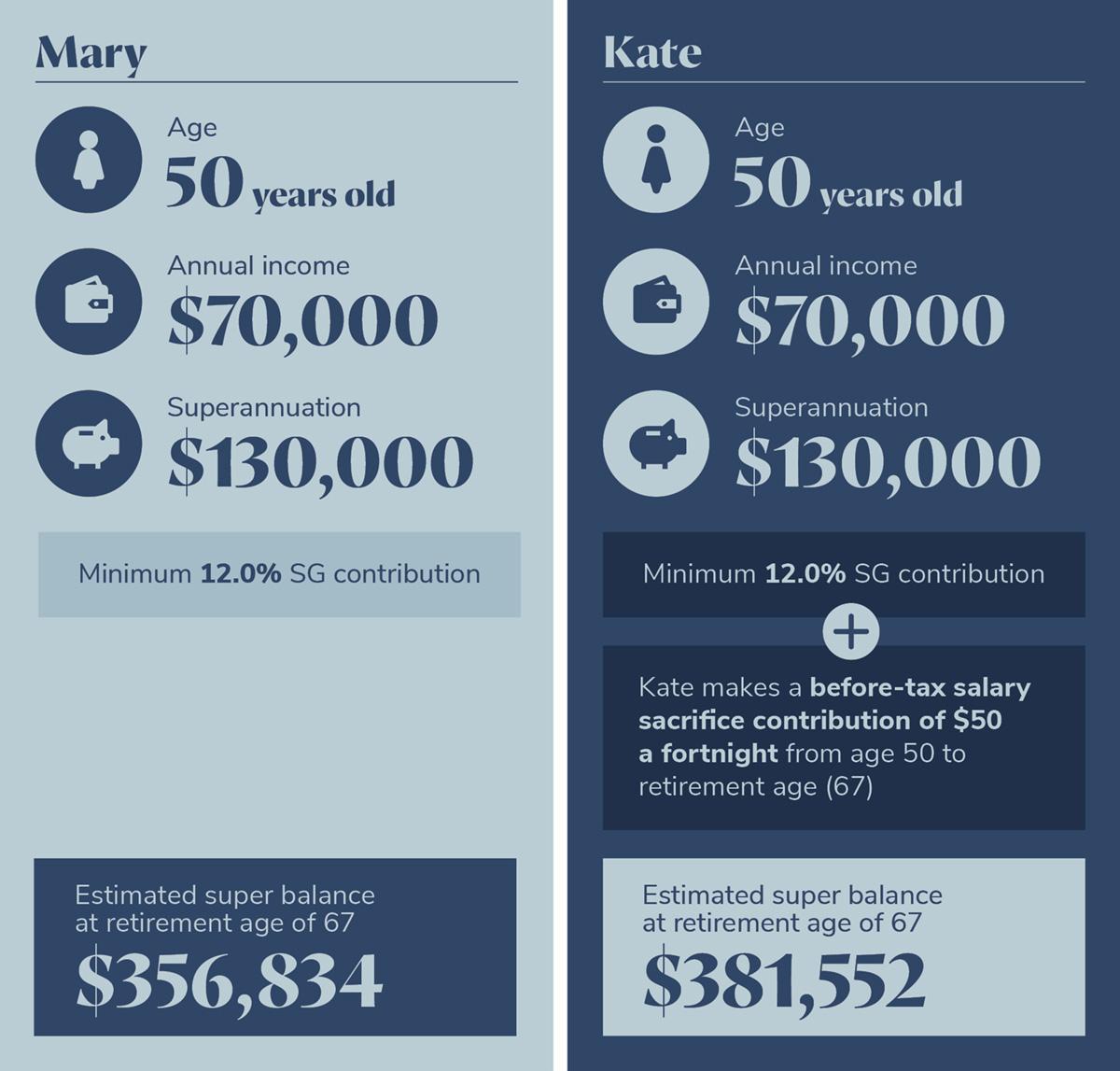 Projected super balances are estimates only based on assumptions and are provided to illustrate the difference salary sacrifice can make. Projected super balances are estimates only based on assumptions and are provided to illustrate the difference salary sacrifice can make.
Assumptions include: Return of 7.5% (before investment fees and earnings tax), 7% tax on earnings, 2.5% inflation and 1.2% rising community living standards, investment fees of 0.85% & admin fees of $74 pa. Insurance costs are not included. Source for projected super balance calculations and assumptions: https://moneysmart.gov.au/how-super-works/superannuation-calculator (assumptions at 27/07/2025). Assumptions may turn out to be incorrect. Projected super balances are not guaranteed. Assumptions used are from the ASIC calculator, refer to calculator for all relevant assumptions. The benefits of salary sacrifice contributions for you will depend on your individual circumstances.
Of course, you need to bear in mind the contributions caps explained above and what tax is payable if you exceed your cap.
Salary sacrificing isn’t for everyone, and there may be other strategies that suit you better. So we recommend you seek advice about what’s right in your personal circumstances. A Vision Super limited financial planner can explain the benefits of salary sacrifice and how it can help you to grow your super. This type of advice is generally available to Vision Super members at no additional cost. Request an appointment now. [add a link]
|
Any advice in this article is general only and has been issued by Vision Super Pty Ltd (ABN 50 082 924 561) (AFSL 225054) as the Trustee of the Local Authorities Superannuation Fund (ABN: 24 496 637 884) (‘Vision Super’). The advice does not take into account your personal objectives, financial situations or needs. Before acting on the advice, you should consider whether it is appropriate for you, having regard to your own circumstances, and obtain the appropriate Product Disclosure Statements (PDS) / Member Guides and Target Market Determination (TMD) available at www.visionsuper.com.au