On 28 February 2026, the US and Israel carried out joint military strikes on Iran. Iran responded with attacks across the Gulf region. Most of the damage has occurred in Iran, but other countries in the region have also been affected.
A major concern for investors is the impact on global energy supply. About 20% of the world’s oil and gas normally passes through the Strait of Hormuz, which is now effectively closed. Because of this, energy prices—especially oil—have risen sharply. Higher energy prices usually slow global economic activity and increase inflation.
As a result, equity markets have fallen, especially in countries that rely heavily on oil from the Middle East. In local currency terms, the MSCI All Countries Index fell 3.4% between 27 February (last trading day before the conflict commenced) and 9 March 2026. All the markets shown in the chart below, except the US, dropped at least 6%. The US performed better partly because it is less dependent on imported energy.
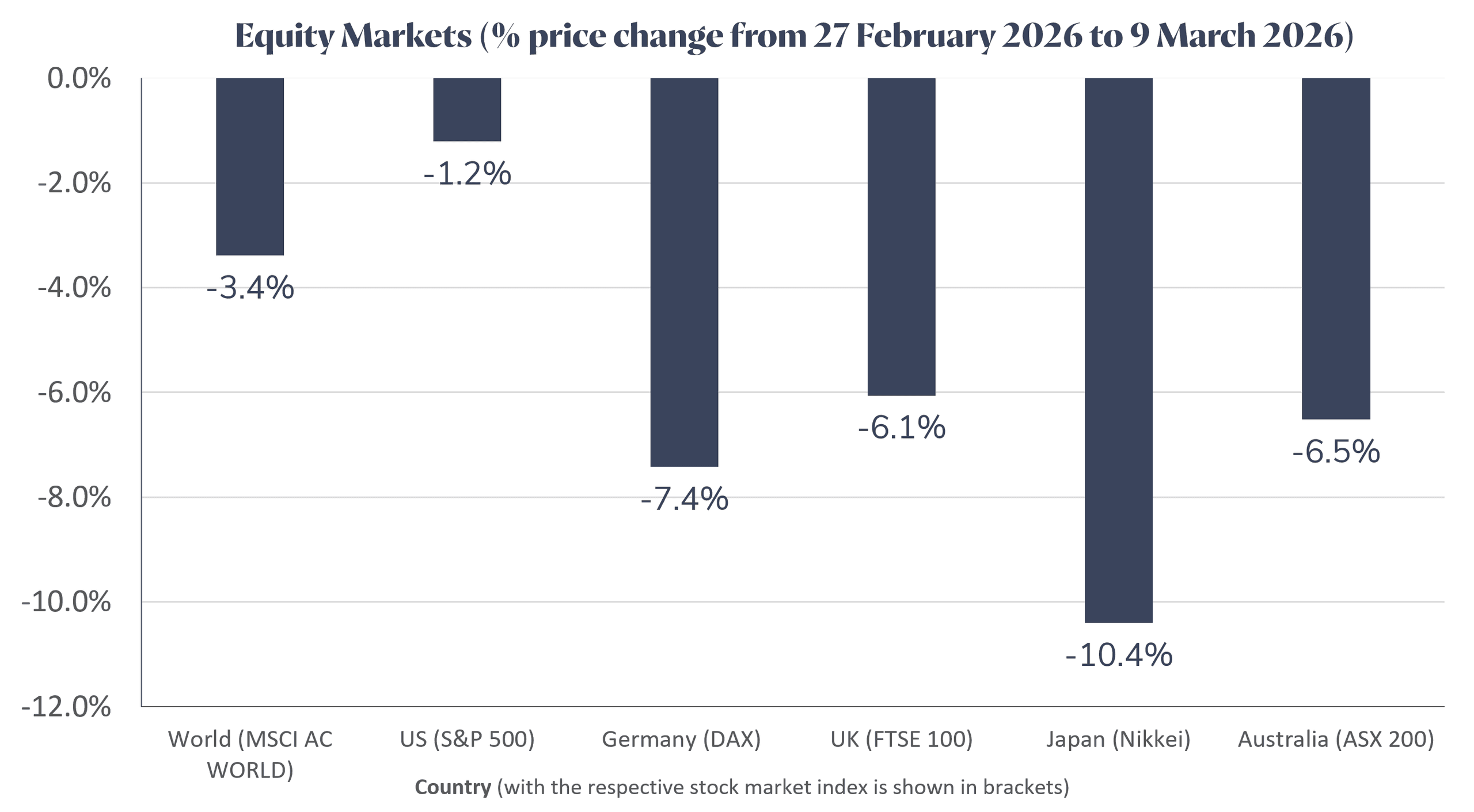
Historically, geopolitical events tend to cause only short-term market disruptions and don’t usually lead to large, lasting market corrections. For example, the US and Israel strike on Iran in mid-2025 had only a small, temporary impact on markets. Investors seem to expect a similar outcome this time. Oil futures prices suggest that the oil price may peak soon and return to near pre-conflict levels by the end of the year.
The outlook for the current conflict in the Middle East is uncertain, and the situation is evolving quickly. While there is a wide range of possible scenarios, three are outlined below:
Fast Resolution: If the conflict ends in the next couple of weeks, equity markets would likely rise and bond yields would fall. Some recent comments from the US Administration support this possibility.
Consensus Scenario: Many analysts expect the conflict to be resolved within a few weeks. Markets may stay volatile until then, and equity markets could fall further before improving. In this case, the global economic impact would probably be limited and equity markets could rebound.
Extended Period of High Oil Prices: If high oil prices last for many months, the global and Australian economies—and equity markets—would face more significant challenges. The US is likely keen to avoid this outcome because it could hurt Republicans’ prospects in the November 2026 mid-term elections.
Overall, the most likely scenario appears to be a short-term conflict, as President Trump has strong political incentives to limit the economic and electoral impact. We will continue to monitor developments closely.
Investment returns are not guaranteed. Past performance is not a reliable indicator of future returns.
Issued by Vision Super Pty Ltd ABN 50 082 924 561 AFSL 225054. This information is general advice which does not take into account your personal financial objectives, situation or needs. Before making a decision about Vision Super, you should think about your financial requirements and consider the relevant Product Disclosure Statement and Target Market Determination